Friday, July 31, 2009

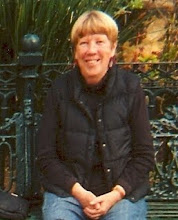
Photographer Marcey Jacobsen 19ll-2009 (Homage)

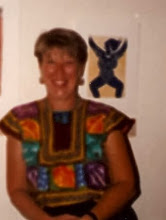
Friends Marcey Jacobsen (left) and Kiki Suarez (right) at Hotel Casa Mexicana in San Cristobal de las Casas, Chiapas, Mexico. Taken during my last visit some years ago after lunch together. Remembering and honoring Marcey today and my two friends.

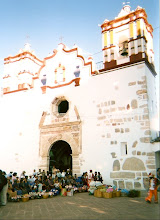
Photo by Marcey Jacobsen from the street outside her house and garden in San Cristobal de Las Casas, Chiapas, Mexico.

Marcey passed over on July 26, 2009. It was a privilege to know her.


You can find her photos of life in the highlands of Chiapas in her book called The Burden of Time published by Stanford University Press. I believe she lived in San Cristobal for at least 50 years, spending time in New York to earn money to support her life and photography.

She gave me this print and another as a reward for getting some developing trays to her during the early 90's. I put the large stainless steel trays in my suitcases to Oaxaca. A man I met in Oaxaca took them to Marcey in San Cristobal

link to nytimes blog with Marcey's photos and more information http://lens.blogs.nytimes.com/2009/08/13/parting


Monday, July 6, 2009

Mitzi Linn's Annual Studio Sale

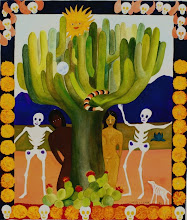
Gouache painting "Adam and Eve visit the Happy Angel Resort" copyright Mitzi Linn

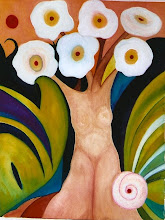
Gouache Painting: " Womantrees Dancing: Divas" copyright Mitzi Linn

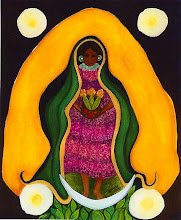
Gouache Painting "Oaxaca II--2004" copyright Mitzi Linn
Gouache Painting "Oaxacascape: Fiery Sunset" copyright Mitzi Linn

These paintings can be seen at my studio sale in Eugene, Oregon. Please email me at mitzi_linn@yahoo.com if you'd like more information about the sale or the paintings. Enjoy!

Monday, June 29, 2009

Deer

Gouache Painting--Waterwoman visits Sonoma

Deer (excerpt from longer poem)

I have become enamored with deer.
They cross the yard, eating willow leaves
and ground covers. The doe has shown her baby
once, awkwardly standing in the neighbors’
yard with them sitting in plastic white chairs.
The neighbors made no moves.
The old woman talked kindly while
throwing the doe apples. These neighbors fenced
a garden on the deers’ route. The sign
on the gate says “The Buck Stops Here”,

At Sugarloaf Park, in Sonoma, this spring,
I had an eight deer morning.
They graced my isolated campsite.
Only ears and antlers told of their presence
in tall grasses climbing above their shoulders,
green turning golden by early June.
I lay watching their private showing.
I loved them as much as I loved the trail horses
penned at the barn. I smiled at
does teaching their fawns to eat baled hay,
stacked behind the corral.

Loving deer brings joy and sorrow.
They are so quiet, graceful, beautiful......
Those lasting glimpses.
I struggle to accept their suffering, against which
Their grace and beauty offer no shield.

The part of me they speak to is the
One that never wants wilderness to end,
the One who never wants to have to grow up
and fit into the real world. The One
who always wants to disappear into the
shadows of the bay laurel
or backyard weeping-willow.
To be able to forage off the land,
Never be fenced in or out.
And live in perpetual summer.

1997

At a potluck with friends last night Tina reminded me of the painting above. This summer housesitting again where the deer cross the yard daily, and having spent years seeing new fawns, the doe in the poem is at least the grandmother of the current ones that I see leading their tiny fawns through the break in the fence towards Gig and Ken's house where they lounge in the shade.

Wednesday, June 17, 2009

The Bananaleaf Series

Gouache Painting The Bananaleaf Series: Magic Evening

This series started in the spring of 1993 in Oaxaca. Within the tropical landscape, inspired by the Oaxaca coast scenery, you find two faceless women.....to say that human beings are part of the earth herself. In other paintings in the series, the bodies are less discernible as female. Still, I value the feminine and the spiritual feminine and the rebirth of that energy in the last 40 + years. We need the nurturing of our Mother Earth and the point of view of feminism and deep ecology.

Tuesday, June 2, 2009

The Blue Dakini

Gouache painting "The Blue Dakini" 1991

For the Yogi

The Dakini danced before his very eyes.
She danced inside him.
He became warm, then hot,
with a kind of passion,
Burning
to possess her
to dance with her
to connect with her
to make love to her.

The only way was to dance,
to become one with her
never-faltering energy.

Then, it was easy to let go
to not want
to not have to have
to not need.

Just be

Easter 1991, Oaxaca
From Chapbook "We put our bones together"

Sunday, May 24, 2009

From the Plaza (Gouache Painting)


The first image is my painting, evoking a grand old church, of which there are many in downtown Oaxaca. This one may be in some pueblo in the valley with the magical blue horse hanging out near an anthropomorphic urn with calla lillies. Actually, Templo Santo Domingo was the inspiration for this painting and others in the small group.

The second image (a postcard) is of dancers on the plaza in front of Templo Santo Domingo performing the Dance of the Pineapple. This dance comes from the tropical area of the state of Oaxaca around Tuxtepec. The beautiful young women wear huipiles (handwoven dresses) representing that area. This dance seems to represent young women's puberty dance--presenting themselves to the pueblo (people). The pineapple is the perfect symbol of the matriz.

Dancers gather to celebrate many things in downtown Oaxaca--sometimes for a public show and sometimes for private events, like marriages at Santo Domingo. Oaxaquenos enjoy the colorful folklorico presentations complete with traditional live music from local bands. It is common to see a group of young people practicing dances in El Llano Park. I love the dances, so energetic, sensual, entertaining, vibrant!

Sunday, May 17, 2009

La Alma de Oaxaca

Gouache Painting by Mitzi Linn "Oaxacascape: City Street"

I love the old adobe and green stone (cantara) architecture of Oaxaca's "El Centro". Living near Santo Domingo in 1988/89, and walking daily through the zocalo on my way to the market, I could see the natural hills and mountains surrounding the small city. I never thought of it as a "colonial city" though Cortes himself built a house there and one time I housesat one of the oldest houses in Oaxaca.

Oaxaca has grown dramatically since 1995. It is a world class tourist destination, named a World Heritage Site by UNESCO in the 1990's. Many of the old buildings have been restored and some are now museums and libraries, as well as cultural centers. Pedestrian streets opened up. Now it is a "colonial city" in tourist brochures.

People from all over Mexico moved to Oaxaca too, increasing the local population in the valley to a million (or more) people. When I started living part time in Oaxaca in the late 80's, the population was under 200,000 in the valley. Then there were hardly any cars on the streets because credit to buy them was not available. Walking in the city was an intense pleasure. The blooming trees, the quiet neighborhoods.......

A small community of artists, musicians and creative types found each other at El Sol y La Luna restraurant for good food and drink, art exhibits and live music. Then we moved on to La Candela and Los Guajiros to dance to Cuban music. We met at art openings at La Mano Magica and Arte de Oaxaca. I felt a welcome part of this Oaxacan and international scene. It encouraged me to become an artist--the midlife choice that gave me a renewed appreciation of culture and creative expression.

Thursday, May 14, 2009

Floral Textiles from Oaxaca


I am posting some examples of Oaxacan embroidery from a textile show several years ago in Oaxaca city. Now there is a textile museum which preserves the beautiful works of women and men artisans. An offering for springing into summer.

Sunday, May 3, 2009

Monte Alban--Sacred Ceremonial City

Gouache painting--Oaxacascape: Mercado below, Monte Alban above

Influenced by the Olmecs, the Zapotecs built Monte Alban(Danibaan in Zapotec) on a mountaintop near what is now the city of Oaxaca. Construction began in 500 BC. The site was abandoned around 800 AD. Monte Alban functioned as an inhabited sacred space for over 1000 years, at least 1500 years before the Aztecs came to power in 1200 AD in central Mexico. According to Marcus Winter, an INAH archaeologist who helped excavate it, Monte Alban was one of the first ceremonial cities built by any culture in Mesoamerica. The top of the mountain was leveled and pyramidal bases with temples on top were constructed on an immense flat plaza. They flattened the mountain top without draft animals, wheels or slaves-- an act of devotion to their pantheon of deities. From Oaxaca city you can look up and see the tree and stone walls of the North Temple Complex miles away.

Although Monte Alban wasn’t "discovered" by outsiders until the 20th century, the locals continued to use it as a ceremonial place after its abandonment between the 9th-11th century. Shamans, priests,kings, midwifes and commoners climbed the sacred mountain to make prayers and rituals on top of earth covered pyramids which looked like mounds. So, Monte Alban, while abandoned as a public ceremonial center, continued to be used as a revered, sacred space.

Linda Schele (The Mayan Cosmos) said that the Mayans destroyed their pyramids on purpose and covered them with earth when they abandoned their cities around 800 AD. It was their way of “closing” down these sacred, energy centers. I assume the Zapotecs did the same. Local farmers started planting corn in the old plazas. Danibaan seemed to return to nature. Hernando Cortez and his soldiers never saw the old city on the mountaintop.

Going to Oaxaca, where the archaic integrates with the modern, I finally discovered our continent’s ancient, pre-European civilizations. Standing on a pyramidal temple base at Monte Alban in 1982, I remembered the overgrown "Indian" mound I played on as a child in southern Indiana--it too was built around 500 BC. I intuitively understood their connection. It inspired me to dig into the mystery of our old cultures in the Americas.

excerpt from "Mi Querida Oaxaca" an unpublished manuscript by Mitzi Linn

Sunday, April 26, 2009

Prehispanic Dance Figure

Gouache painting "Zapotec Star Figure: the Pleiades"

This painting was inspired by a stone carving I found at a museum in Oaxaca. The carving was the figure with a sun/moon eclipse face on a block of stone. The figure looks like a dancer. I added the thunderbolt symbols to symbolize energy, and spirals representing stars.

A young Zapotec looked at it and told me that the figure represents the Pleiades, a star group really important to Mesoamerican cultures. The Zapotec culture at Oaxaca may have created the first Mesoamerican calendar.

I feel a connection to the Pleiades, that tiny kite formation that travels across the northern winter night sky.

Pleiades Fly Overhead (poem)

As if time itself has meaning
and space lies beyond it.
or, as if the brevity of a single breath
encompasses a moment of
recognition.

Words distract the truth.
Freedom distills moments.
Divine liquor drops onto our
parched tongues.

Whether it is a god of suffering,
a compassionate mother of all beings,
or a flash of colliding angels,

Awestruck, dumb
Grace enters us,
The clear light.

Oaxaca, 1990

(The
Pleiades has a 52 year cycle. The Sun, Moon, and Venusian calendars also come together every 52 years. 52 years is the “century” cycle of the old Mesoamerican calendars-- Zapotec, Toltec, Mayan, Aztec etc. A new cycle was celebrated every 52 years. The Pleiades is also tied to the annual agricultural cycles of Mesoamerican and Mediterranean Cultures)

Saturday, April 11, 2009

Amor Sin Palabras

Gouache Painting--Oaxacascape : Turtles Rising

Amor Sin Palabras (poem)
(Love Without Words)

1

I am riding the bus called
“Amor Sin Palabras”
from Teotitlan to Oaxaca.
I’m seated alone,
the only guera.

Pueblo querido,
Wrapped in your rebozo
of loving-kindness,
Carrying your precious tlayudas,
Washed in the gold of sunset,
Delighted with the afternoon’s visit,
Full of gratitude for your friendships.
I ride in bliss,
Amor sin palabras.

2

You, shining as we see each other,
Talk with our hearts’ eyes,
Directly,
Without fear or games.

copyright Mitzi Linn 2009

I always like the way buses are named in Mexico.
"Amor Sin Palabras" and another bus called "Amor de Unas Horas’"or
‘Love of a Few Hours’ ran between Oaxaca city and Teotitlan Del Valle
during the 1990's. The names came from titles of Columbian music hits,
the driver informed me. It was those late afternoon, sunset trips back to Oaxaca that inspired the gold/yellow skies that you see in my painting
s.

Missing Oaxaca from the far north tonight!

Saturday, April 4, 2009

The Feathered (Plumed)Serpent


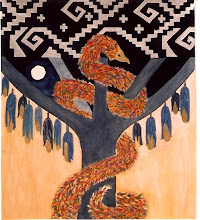
Gouache Painting. "The Feathered Serpent Climbs the Tree of Life--Daystars

Serpents, as symbols of wisdom and transformation, have been found in nearly all ancient cultures. Serpent-power refers to the kundalini energy said to lie sleeping at the base of the spine. It rises up the spine (the tree of life) usually through specific meditation practices or dance. The rising of the kundalini brings ecstatic awareness and enlightenment. Serpents are often identified with the feminine principle and call up the matriarchal roots of modern, patriarchal culture. In this painting the feathered serpent climbs the tree of life. This could symbolize ecstatic awareness.

In Mexico, the feathered serpent refers to the mythological and historical priest-king called Quetzalcoatl. He was a culture bringer, magician and said to be an enlightened being who was against harming others. At least one king held the title of the "the Quetzalcoatl" and it seems there were other emanations of Quetzalcoatl. It was probably a priesthood. One emanation is said to be buried at Tule, Oaxaca under the 2000 year old "Tule" tree--a tree of life.

Quetzalcoatl (the priest-king) was tricked by his brother, broke a taboo and had to leave his home at Tollan. He and his followers visited many parts of Mexico teaching people crafts, language, spiritual practices, and agriculture. In the Gulf of Mexico near Veracruz he sailed into the unknown and turned into the morning star. He predicted his return to the same place in the year 1 Reed....the year Cortes arrived. Many thought Cortes was Quetzalcoatl. That is why Cortes was welcomed at first.

Once in my travels while visiting Walpi (Hopi Mesa) where the serpent has important ritual significance, I was showing these images to my guide, a young woman. She said there is a Hopi prophecy--"when the feathered serpent climbs the tree of life,......" Before she could finish the statement another guide interrupted our conversation. I suppose it is secret information. I wonder if anyone can finish that sentence.


Thursday, March 26, 2009

Aphrodite as the Mermaid

Gouache painting entitled "The New Mermaid"

Poem for Aphrodite

Borne of wind and spray
Lovely Aphrodite
Goddess of Tantra
Bringer of light

You left your freedom for another time
Mother of the Sea, and Eros.
We cannot listen at once
to all you say. Your sounds calm us
They transfix us in this world of
wind and spray.

We left the world of noisy machines
to listen to the insides of shells.
Your secrets reveal us to ourselves
We lie washed up, entangled
in what is and what we dream.

Washed up, about to take wing
You hold our hearts.
You give our spirits wings.


copyright Mitzi Linn, 2009


Wednesday, March 18, 2009

Womantrees: Spring Exuberance


This gouache painting expresses the feelings I have seeing plants flowering and springing forth again, another year, another cycle. Let's join these Womentrees in their springtime dance.

Friday, March 6, 2009

Windhorse

Title: Little Blue Flying Horse by Pop Chalee --Native American artist-- painting on wall of the New Mexico Statehouse


I Ride a Windhorse Across the Sky of Change

An enormous full moon
demands I look up from headlights and
street crossings to acknowledge
our wild beginnings.

I see that our Animal ancestors paused
as they masked themselves as humans,
then stood on two legs to dance together,
no longer recognizable to themselves as Bear, Monkey,
Tiger, Coyote, Turtle, Deer, Snake, Horse, Bird......

They made an evolutionary leap of faith,
Were not able to take off their disguises,
nor return to walking on four legs or flying.

They are mourning their choice, their loss of
connection to the high, dry wild and wetland, forests,
no longer part of their lives.

They relate their stories to each other while dancing,
never stopping to remove their too human faces.
Perhaps the Creator no longer recognizes them,
as they no longer recognize themselves.

Now they dream of liberation through technology,
to move into outer space star worlds,
liberated from their earth animal nature,
encapsuled weightless in a spaceship box,
looking from control panels
into the blackness of passing stars.

The dance goes on and on.
Molecules freeze into passages of unwritten books.
We will only read the lines much later when
the remains of this civilization, this story,
lie buried beneath ash and earth.

Then, as before,
At the openings of dark earth tunnels,
under cliff outcroppings, shelters, past and future,
homecomers from that outer spacebox
will put on animal masks,
pick up the drum and dance Bear, Monkey, Snake
Bird, Coyote, Tiger, Deer, Horse
back from oblivion.

copyright Mitzi Linn, 1997

Sunday, March 1, 2009

Coyote Woman's Passion

Gouache Painting: Pause in the Journey

"Follow the path your heart takes" was the advice given to Carlos Castaneda by Don Juan in The Teachings of Don Juan.

Coyote Woman and her contemporaries read the book while ingesting hallucinogenic substances. They followed Don Juan's advice and started journeys of self discovery, rejecting the materialist environment of the mainstream culture 40 plus years ago.

They created a counter culture within America--based on spiritual values of integrating heart, mind and spirit. Their search continues to experience transcendence within a grounded ideal of community and caring for others.

When you follow your hearts' path, your life will be full of a passion for living, for being awake and making everyday an enlightening journey of awareness, energy and love (compassion). Transcendence is the ultimate goal behind any passion, the source of all creativity.


Sunday, February 22, 2009

Tibetan New Year


Here's an old photo of Venerable Gyaltrul, Rinpoche initiating Kyote--Coyote Woman's longtime dog friend.
Rinpoche once mentioned that Kyote would be reborn as a human being--someone I would know.

It is Tibetan New Year, Losar, on Feb 25.
May all beings be free of suffering!
May all beings be happy--have the causes of happiness!
May the Tibetans be free to practice their religion and culture in Tibet without repression.

Monday, February 16, 2009

Coyote Women Meet in the Zocalo

Painted in Oaxaca in 1993 for El Dia de los Muertos

It's afternoon, the Coyote Women gossip with the Feathered Serpent under a tree in the main square. What could they be talking about? Perhaps the up-coming Mardi Gras comparsa and fiesta that precedes Lent. But then again they could be laughing about their latest adventures or who they are meeting at Bar Jardin later. I can only speculate!

Saturday, February 14, 2009

Coyote Womans bouquet for Valentine's Day


Here's a little present for El Dia del Amor,
In Mexico, we celebrate all kinds of love,
not just romantic love. It is love that heals us.

The painting is of calla lillies in an ancient
anthropomorphic vase, like those found in
tombs of ancient Zapotecs.

Thursday, February 12, 2009

Coyote Woman's Counsel

Coyote Woman Reviews her first 50 Years. Gouache painting by Mitzi Linn


Coyote Woman's Counsel


Coyote Woman Visits Abiqui, New Mexico--Gouache painting by Mitzi Linn

Coyote Woman said I could go out and pluck the moon from the sky.
She then told me to hold it in my palm and make a wish.

Like a pure crystal ball, I offered it to the Universe and
wished to have a free spirit, a loving heart and an adventurous life.

She said I should share it with other beings.